Table of Contents
ToggleHard water is one of those silent problems that costs homeowners money without making a lot of noise, until your shower head clogs, your clothes feel stiff, or your water heater works twice as hard. If you’re considering a water softener system to address mineral buildup, you’re likely wondering: how much does one actually cost? The answer isn’t simple because water softener pricing depends on the system type, your home’s water hardness, installation complexity, and whether you’re tackling DIY setup or hiring a professional. This guide breaks down what homeowners really pay in 2026, covering equipment, installation labor, and the ongoing costs that often catch people off guard.
Key Takeaways
- Ion exchange water softener systems cost $400–$4,000+ depending on capacity and features, making them the most cost-effective option for removing hardness minerals.
- Professional installation labor typically ranges from $800–$2,500, with additional costs for permits ($50–$300) and electrical work ($300–$800) that can significantly increase total system expenses.
- Salt-free water softeners cost $1,500–$3,500 upfront but eliminate ongoing salt purchases (typically $150–$300 yearly), though they condition rather than truly soften water.
- Over a 10-year period, expect total cost of ownership between $3,000–$10,000+ for a water softener system when factoring in equipment, installation, permits, and maintenance.
- Ion exchange systems waste 15–25 gallons per regeneration cycle; demand-initiated models reduce waste significantly but cost $200–$500 more upfront.
- Get multiple quotes from licensed plumbers in your area before purchasing—local labor rates, water discharge regulations, and site conditions vary significantly and affect your final water softener system cost.
Average Water Softener Prices by Type
Water softener costs vary dramatically based on system type. The two primary categories, ion exchange and salt-free systems, operate on completely different principles, and that difference shows up in your wallet.
Ion Exchange Systems
Ion exchange softeners are the traditional workhorses and remain the most cost-effective option for most households. These systems swap out calcium and magnesium ions (the minerals that cause hardness) with sodium ions, actually removing hardness rather than just conditioning the water.
Entry-level ion exchange systems run $400 to $800 for the unit alone. These compact models work fine for small households or those with moderately hard water (less than 15 grains per gallon). If you install it yourself and already have appropriate plumbing access, this is where you stay.
Mid-range ion exchange softeners, the sweet spot for most families, cost $800 to $2,000. These handle harder water, regenerate more efficiently, and include basic smart features or demand-controlled valves that reduce salt waste. A household with 15–25 grains of hardness per gallon typically lands here.
Premium ion exchange systems range from $2,000 to $4,000+ and offer dual-tank setups (so you never run out of soft water during regeneration), advanced metering, Wi-Fi monitoring, and larger capacity. These make sense if you have very hard water or a large household that depletes soft water quickly.
Salt-Free Water Softeners
Salt-free systems don’t remove hardness: they condition water using potassium chloride, template-assisted crystallization, or magnetic/electronic methods. They cost more upfront but eliminate the need to haul bags of salt.
Salt-free softeners range from $1,500 to $3,500 for the unit. They appeal to homeowners who want low maintenance and don’t mind that the water technically remains “hard” (minerals stay in it, just in a form less likely to scale). Some municipalities restrict or tax salt discharge, making salt-free systems the only practical option.
Keep in mind: salt-free systems are more marketing term than true softening. They work well for preventing scale but don’t deliver the same lather improvement or soap efficiency as ion exchange. According to resources like water softener installation guidance, many homeowners find ion exchange solves their actual problem more completely, even if it requires ongoing salt purchases.
Installation and Labor Costs
Equipment cost is only half the story. Getting the system connected to your home’s plumbing is where the real expense often appears.
If your home already has a softener hookup, dedicated cold-water line, drain access, and electrical outlet nearby, DIY installation is feasible for someone with basic plumbing skills. You’re looking at a weekend of work: cutting into the main water line (shutoff valve already present or you install one), assembling the softener unit, connecting inlet and drain lines, and flushing the system. Cost: just your time and maybe $50–$150 in fittings and adapters.
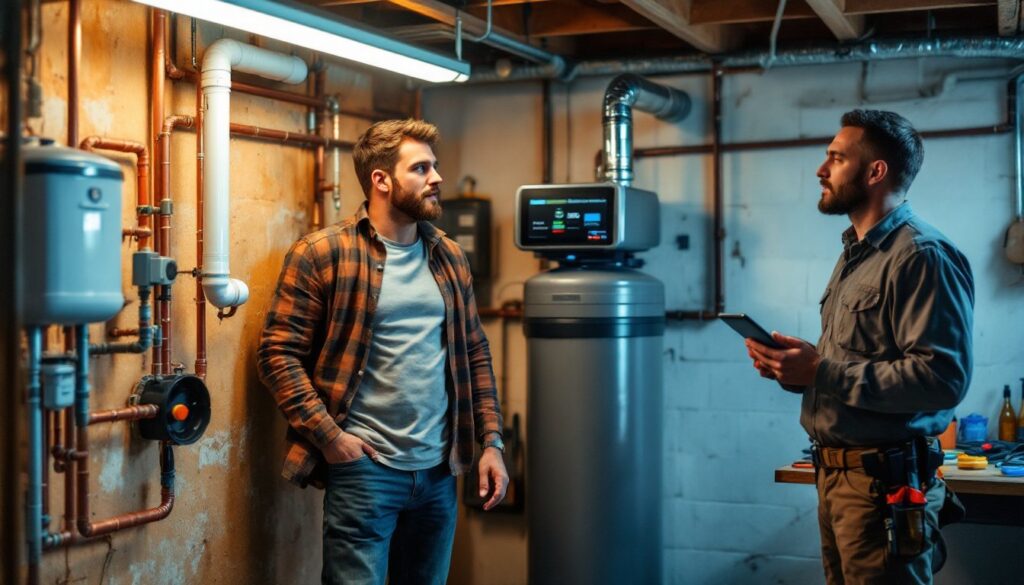
Most homeowners call a professional. Licensed plumbers charge $800 to $2,500 for installation labor, depending on your area and the complexity of your existing plumbing. If your water line runs through concrete, if you lack a convenient drain, or if you need new shutoff valves and bypass fittings, labor climbs toward the higher end. Some regions have higher trade wages than others: a big city or tight labor market adds to the bill.
You’ll also need to account for permits in some jurisdictions. A few municipalities require a licensed plumber to install water treatment systems or issue permits (typically $50–$300). Others don’t. Call your local health department or building inspector before ordering equipment, this catches surprises before installation day.
Electrical work is another variable. Most softeners need a standard 110V outlet within 6 feet of the unit. If you don’t have one, you’re paying an electrician $300–$800 to run a dedicated circuit. This is licensed work in most places and shouldn’t be DIY.
Total installation range: $800 to $3,300+ for professional installation with permits and possible electrical work. That pushes your whole-system cost, equipment plus installation, into the $1,600 to $7,300 range depending on system quality and site conditions. Platforms like Angi and ImproveNet let you get multiple quotes in your area so you’re not flying blind on local labor rates.
Long-Term Maintenance and Operating Expenses
After the system is running, you’ll face recurring costs that add up over years.
Salt or potassium chloride: If you chose an ion exchange softener, you’ll buy 25–40-pound bags of softener salt every 4–8 weeks, depending on your water hardness and household size. A bag costs $8–$15 at big-box retailers. That’s roughly $150–$300 per year in salt. Salt-free systems avoid this entirely, which appeals to environmentally conscious homeowners or those in areas where salt discharge is restricted.
Water waste: Ion exchange softeners discharge brine during the regeneration cycle. A typical system wastes 15–25 gallons of water per regeneration, which can mean 500–2,000 gallons per month depending on your settings and household size. Some areas charge for waste water, or environmentalists object to salt entering municipal treatment systems. Demand-initiated softeners (which regenerate only when needed, not on a timer) reduce this waste significantly but cost $200–$500 more upfront.
Maintenance calls: Most systems run trouble-free for years, but mineral accumulation in pipes, valve seals wearing out, or salt bridges forming occasionally require professional service. Budget $150–$500 every few years for maintenance or repairs. A warranty (typically 3–5 years on the tank, 1 year on the valve) covers defects but not wear items.
Tank replacement: A well-maintained ion exchange tank lasts 15–20 years. When it fails, replacing it costs $800–$2,500 (parts and labor). This isn’t imminent for most people, but it’s worth mentioning if you’re calculating lifetime cost. Salt-free systems have similar lifespans.
Over a 10-year ownership period, expect to spend $1,500–$3,000 on salt and miscellaneous maintenance for an ion exchange system, or almost nothing ongoing for a salt-free system (minus the occasional professional service). When you factor in the equipment and installation cost, your total cost of ownership usually runs $3,000–$10,000+ over a decade, depending on system choice and local water/labor costs.
Conclusion
A water softener system isn’t a one-time purchase price: it’s an ecosystem of equipment, labor, permits, and ongoing maintenance. Ion exchange softeners offer the best return on investment for most homeowners, cheaper upfront and proven to solve hard water problems, but they demand salt and water. Salt-free options cost more initially and won’t remove hardness, yet they’re maintenance-light and suitable for areas with strict discharge rules. Get three quotes from local plumbers, ask about warranty terms, and factor in your region’s salt costs and local labor rates. The true cost of your water softener will be unique to your situation, but now you know where to look.