Table of Contents
ToggleIndoor climbing plants are making a serious comeback in home design, and for good reason. They’re not just Instagram-worthy: they’re functional living decor that improves air quality, softens hard edges, and adds lush greenery without eating up floor space. Whether you’re working with a bare corner, a plain wall, or a balcony railing, climbing plants let you grow upward instead of outward, ideal when square footage is tight. The best part? Most indoor climbers are forgiving enough for beginners yet versatile enough to create genuinely impressive living walls.
Key Takeaways
- Indoor climbing plants transform blank walls into focal points while improving air quality and requiring minimal floor space—perfect for small living areas.
- Beginner-friendly options like pothos and philodendrons are nearly impossible to kill, tolerating low light and irregular watering while reaching 3–6 feet within 12 months.
- Proper support systems such as moss poles or wall-mounted trellises are essential, positioned 1–2 inches from walls to allow airflow and prevent mold or pest issues.
- Indoor climbers thrive with minimal care: water when the top inch of soil feels dry, provide low to medium indirect light, and fertilize only every 4–6 weeks during growing season.
- Living walls, corner installations, and shelving sequences create dramatic displays, while workspace and bathroom setups leverage climbing plants to reduce stress and boost productivity.
Why Indoor Climbing Plants Are Perfect for Home Decor
Climbing plants solve real decorating problems. They transform blank walls into focal points, hide eyesores like exposed pipes or ugly corners, and break up large, empty vertical spaces without requiring permanent installation like wallpaper or paint. Unlike static art, they’re living and breathing, they grow, change seasonally, and create an organic, layered look that trendy furnishings can’t match.
From a practical standpoint, trailing and climbing houseplants are low-commitment. They don’t demand perfect lighting conditions like finicky flowering plants, and they’re genuinely low-maintenance once established. Many tolerate neglect better than common houseplants: if you forget to water for a week, most climbers shrug it off. They also purify air more efficiently per square inch than compact houseplants because of their larger surface area.
There’s also a psychological angle. Biophilic design, incorporating natural elements into indoor spaces, reduces stress and boosts mood. A lush wall of climbing greenery does that work for you, and it costs far less than a living wall system or vertical garden installation. You’re essentially bringing nature indoors without hiring a contractor.
Best Indoor Climbing Plants for Beginners
Pothos and Philodendrons: Bulletproof Options
Pothos (Epipremnum aureum) and Heart-leaf Philodendron (Philodendron hederaceum) are the gold standard for beginners, they’re nearly impossible to kill. Both tolerate low light, irregular watering, and temperature swings that would stress other plants. Pothos trails or climbs depending on how you train it, with heart-shaped leaves in solid green or variegated patterns. Philodendrons are similar but slightly more compact and even more forgiving with neglect.
Both reach 3–6 feet easily in 12 months with minimal care, and they’re cheap to start with (usually $5–15 for a small starter plant). They can handle offices, bathrooms, and dim bedrooms where light is sketchy. Pothos is especially good for shelves or high shelving, where it cascades dramatically. If training upward, they’ll naturally latch onto a moss pole or trellis with aerial rootlets, though they don’t require it. The main thing? Avoid soggy soil. Overwatering kills far more pothos than underwatering ever will.
Ivy Varieties and Other Hardy Climbers
English Ivy (Hedera helix) brings a classic, cascading look and grows vigorously in average indoor conditions. It prefers cooler temperatures (60–70°F) and moderate indirect light, making it ideal for north-facing windows or living rooms away from heat sources. Indoors, it’s less aggressive than its outdoor counterpart, so it won’t take over your apartment. Several cultivars exist with variegated or deeply lobed leaves if you want more visual interest.
Syngonium podophyllum (Arrowhead Plant) is another gem for beginners. It grows as a compact climber with arrow-shaped leaves in solid green, pink, or white varieties. It tolerates humidity swings and low light better than most climbers and has a more delicate, refined appearance than pothos. It reaches 3–4 feet with training and climbs beautifully on a moss pole.
Hoya carnosa (Wax Plant) is a slower, more ornamental climber with thick, waxy leaves and fragrant pink or white flowers once mature. It’s more drought-tolerant than pothos and prefers bright, indirect light. If you want something that flowers indoors, hoya rewards patience, wait for the payoff of those sweet-smelling clusters.
Setting Up Support Systems and Trellises
You can’t just hang a climbing plant and expect it to figure out how to climb on its own, you need structure. The simplest option is a moss pole (a 2–4-foot stake wrapped in sphagnum moss or coco coir). Plants with aerial rootlets, like pothos and philodendrons, naturally grip and climb moss poles. They’re $10–30 depending on size, and you can even DIY one by wrapping moss around a PVC pipe or wooden dowel secured in the soil.
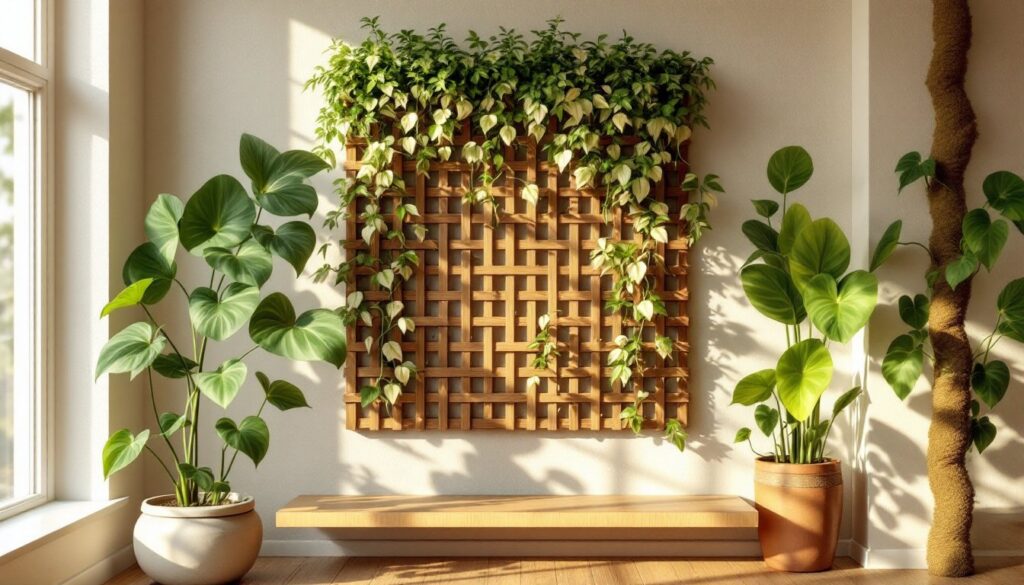
For walls, lean into wall-mounted trellises in wood, plastic, or metal. These give plants a framework to climb or weave through. Install them using appropriate anchors for your wall type, studs for heavy installations, heavy-duty drywall anchors for standard drywall, or command hooks for renters who can’t drill. Make sure the trellis is positioned slightly away from the wall (1–2 inches) so air can circulate around stems and prevent mold or pest issues. Plants need wiggle room to grow and spread.
Floating shelves also work as impromptu support. Place them at staggered heights so vines can climb from one to the next, creating a natural waterfall effect as they trail downward.
Secure everything firmly. A pothos or philodendron can weigh 5–10 pounds once mature and fully watered. If your setup is wobbly or poorly anchored, it won’t just look unstable, it’ll eventually fail and damage your wall or floor. Test it by pushing with force before planting. Also, avoid placing climbing plants directly against painted walls where moisture might trap and cause paint failure or mold growth. Give them breathing room.
Essential Care Tips for Thriving Climbers
Watering is where most people stumble. Indoor climbers like soil that’s moist but not waterlogged. Water when the top inch of soil feels dry to the touch, usually once a week in growing season, less in winter. Stick your finger in the soil: don’t just eyeball it. Pot size matters: a small 4-inch pot dries faster than a 10-inch pot, so adjust frequency accordingly. If sitting in a cache pot without drainage holes, be extra cautious about root rot.
Light requirements vary by plant but most indoor climbers tolerate low to medium indirect light. Pothos and philodendrons genuinely thrive in offices with fluorescent overhead lighting. Variegated varieties (cream and green patterns) need slightly brighter light to maintain their markings: all-green types forgive dimmer corners. South or west-facing windows with filtered sunlight are ideal if available, but east or north windows work fine too.
Humidity helps but isn’t essential. Most indoor climbers adapt to average household humidity (40–50%). Bathrooms are naturally more humid and ideal locations. If leaves yellow or brown at the tips, low humidity or mineral buildup in water might be the culprit, misting weekly or grouping plants together can help, or use distilled water occasionally.
Feeding is minimal. A balanced, diluted liquid fertilizer (10-10-10 NPK) every 4–6 weeks during growing season (spring and summer) is plenty. Don’t fertilize in fall or winter when growth slows. Overfertilizing causes salt buildup and actually damages plants, so less is more.
Training plants to climb requires patience and tie-downs. As new growth emerges, gently guide stems toward your support structure and loosely tie them with soft twine or plant clips. Avoid tight knots that cut into stems as they thicken. Within 2–4 weeks, aerial rootlets will latch on and do most of the work themselves.
Creative Ways to Display Climbing Plants Throughout Your Home
Living walls are the showstopper move. Mount a trellis panel on an accent wall and train multiple plants, pothos, philodendrons, and ivy, to weave together at different levels. Stagger heights so they grow at different rates and create visual depth. Everything You Need to Know About Houseplant Vines provides expert training techniques for complex wall displays.
Corner installations work brilliantly for renters. Position a tall moss pole in a corner, plant a pothos at the base, and let it climb 5–6 feet. The corner shields the plant from traffic and drafts, and it fills dead space that’s otherwise hard to decorate.
Shelving sequences let plants cascade naturally. Place trailing varieties on upper shelves and let them flow downward, with climbers on lower shelves growing upward toward them. This creates a lush, tiered effect that’s less “curated” and more “wild garden indoors.”
Doorway or window frames are underrated spots. Train ivy or syngonium around a window frame or above a doorway to frame the opening. Use removable adhesive hooks or install a thin wire trellis, no permanent damage.
Bathroom haven setups are ideal. High humidity, indirect light from frosted windows, and moist air make bathrooms paradise for climbers. A pothos on a shelf, syngonium on a wall trellis, and english ivy trailing from a high ledge create a spa-like atmosphere. Better Homes & Gardens has countless ideas for leveraging moisture-loving plants in small spaces.
Workspace green walls boost productivity and air quality. A compact trellis behind a desk or on a side wall with fast-growing pothos adds visual interest and keeps the space calm. Studies from horticulture and workplace design fields consistently show that nearby plants reduce stress and improve focus. The Spruce offers solid guidance on office plant placement and care.